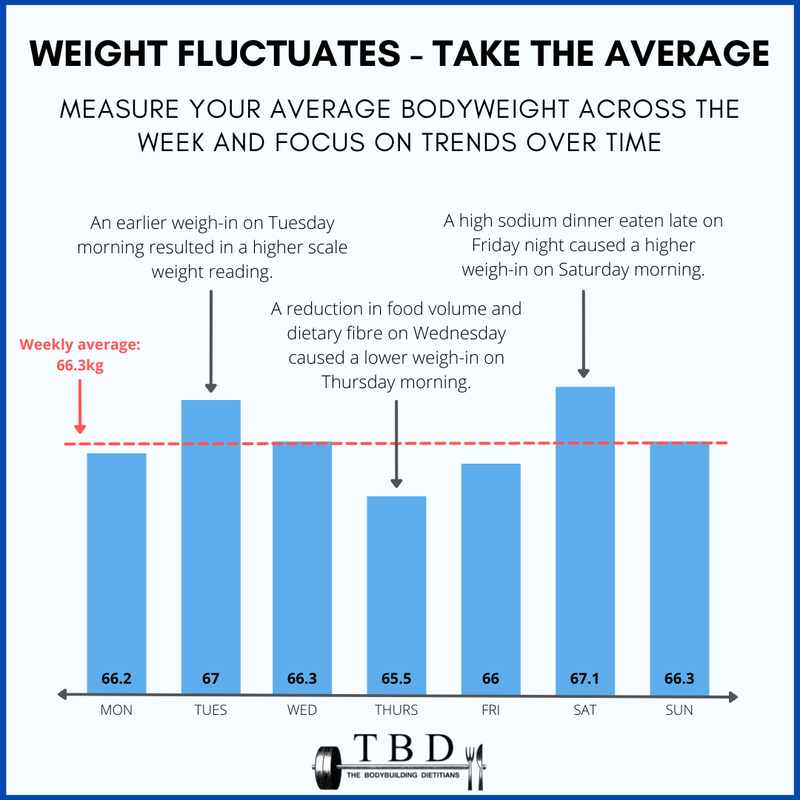
Monday: 174.2 lbs. Tuesday: 176.8 lbs. Wednesday: 173.5 lbs. Thursday: 175.1 lbs. If I didn't know better, I'd think my scale was broken. Or that I was gaining and losing three pounds of fat every forty-eight hours. Neither is true. Daily weight fluctuation is normal, predictable, and mostly unrelated to fat loss or gain.
The biggest driver is water. Your body is 60% water, and that percentage moves around constantly. Eat a salty dinner? You retain water. Drink a gallon of water? You weigh more temporarily. Sweat during a workout? You weigh less until you rehydrate. Carbohydrates also cause water retention — each gram of glycogen binds three to four grams of water. A high-carb day can add two to three pounds of water weight by morning.
Hormones matter too, especially for women. Menstrual cycles can cause water retention fluctuations of several pounds. Cortisol from stress does the same. Even the timing of your bathroom routine affects the number. Weigh yourself before versus after, and you'll see a half-pound difference.
I once did an experiment to quantify the fluctuations. For two weeks, I weighed myself four times a day: first thing in the morning, after breakfast, after lunch, and before bed. The range was staggering. My morning weight was consistently 173-175 pounds. My evening weight was 178-181 pounds. That's a six-pound swing within a single day — all from food, water, and normal bodily processes.
The post-workout weigh-in was particularly misleading. I'd finish a run, weigh myself, and be "down" two pounds. But that was just sweat loss. Two glasses of water later, I was back to baseline. If I had celebrated the post-run number as "progress," I'd have been deluding myself. The only number that mattered was the morning number, measured under identical conditions.
Hormonal fluctuations added another layer of complexity. I don't have menstrual cycles, but I tracked my data alongside my girlfriend's. Her daily weight could swing 3-5 pounds depending on where she was in her cycle — entirely normal, entirely predictable, entirely unrelated to fat gain or loss. If she didn't know this, she'd have thought her diet was failing every month.
The practical takeaway is simple but hard to internalize: trust the process, not the daily number. If your calorie intake is controlled and your activity is consistent, the trend will move in the right direction over time. The daily fluctuations are just weather. The trend is the climate. You can't control the weather, but you can dress for the climate.
I used to let these fluctuations dictate my mood. A "good" number meant I was succeeding. A "bad" number meant I was failing. It was exhausting. Now I weigh myself daily but only look at the seven-day average. The daily number goes into the spreadsheet and gets ignored. The average is what I care about.
Here's a practical tip: weigh yourself at the same time every day, under the same conditions. I do it every Saturday morning, after using the bathroom, before eating or drinking. Even then, there's variation. But it's minimized. And I never weigh myself the morning after a restaurant dinner. That's just asking for disappointment.
The scale is a tool, not a judge. It reports mass. It doesn't report fat. It doesn't report health. It doesn't report worth. Learning to separate the number from the emotion took me months, but it was the most important mental shift in my entire tracking journey.
I also started tracking my weight alongside my food log to identify personal patterns. For me, dairy causes a 1-2 pound water retention spike the next day. High sodium meals do the same. Alcohol adds 2-3 pounds for 48 hours. These aren't universal — they're my personal responses. But knowing them helps me interpret the scale without panic.
The scale manufacturers don't help. They market their products as precision instruments, implying that every decimal place matters. It doesn't. Your body weight naturally varies by 2-4 pounds daily. A scale that measures to 0.1 pounds is giving you false precision. It's like measuring the ocean with a ruler. The tool is more precise than the system it's measuring.
What's the biggest single-day weight swing you've ever seen on your scale?
I once tested the extremes of daily fluctuation deliberately. I ate a high-sodium, high-carb dinner and weighed myself the next morning: 178.2 pounds. Then I drank a gallon of water throughout the day, ate clean, and weighed the following morning: 174.8 pounds. That is a 3.4-pound swing in 48 hours with zero fat loss or gain. It was all water, glycogen, and digestive contents. The experiment was uncomfortable but educational. I never panic about daily numbers anymore.
Your body is not a machine. It's a complex biological system that responds to hormones, hydration, sleep, stress, and a hundred other variables. Expecting it to produce the same number every day is like expecting the stock market to go up every single day. It doesn't work that way. Embrace the noise. Track the trend. Stay patient.